PROLOGUE
It is Wednesday, May 24, 2000. The spring sun is slowly setting on a warm night in Rochester, New York. Five young men, who spend their free time playing in a rock band called Filmshow, are waiting anxiously backstage prior to performing their debut gig at one of the city's favorite venues, Water Street Music Hall. It isn't often that they play live in front of an audience, so the band feels some self-imposed pressure begin to take hold.
Dave asks them to just line up together in front of the concert hall's brick rear wall; it's a suitable backdrop for a quick pic. He asks the guys to move closer so they're all in frame. Closer. No really guys, closer. Ok, that's fine.
CLICK.
CLICK.
CLICK.
Three snaps and it's over.
The restless band head back inside. SHOWTIME. They climb the stairs to the stage with anticipation, donning their instruments with shaky hands. And off they go...
Their performance at the start is solid, uneventful, workmanlike. They gradually loosen up and have fun, and the audience of friends and music scene regulars register their approval with warm applause and the odd hoot. After their set, the band exhale and head into the crowd, exhilarated yet relieved. The post-performance drinks begin to flow. It's been a good night.
A few days later, the promoter's website posts some raw video footage from Filmshow's set, along with the "best" of the three promo photos taken before the set.
When the band sees the photo, they cringe. And shrug. And laugh. And some absurd ideas are born.
- -
CHAPTER ONE: WTF?
Below, you see a fake advertisement, for a fake record, by a fake late-1970s band called Filmshow. Confusingly, it is based on a picture of my real early-2000s band, also named Filmshow. Why we didn't create a new name for this bogus band, I have no idea.
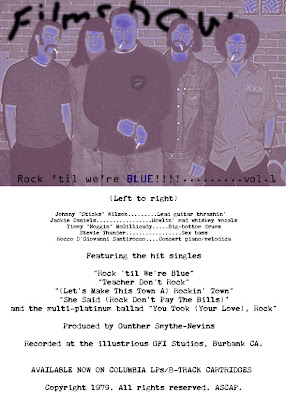
I can assure you that the description and appearance bear almost no resemblance to the real Filmshow. This ad was cooked up by me, our drummer Joe, and someone else (one of the other band members, or possibly Joe's cousin Adam, I can't remember who) when we were bored one evening in Summer 2000. We thought the original pic was full of so many rock cliches (brick wall! pouty faces!) that we decided to make fun of ourselves. Simple as that.
Let's break down the photo, from top to bottom...
CHAPTER TWO: THE BAND MEMBERS (L-R)
- Johnny "Sticks" Wilson: a play on the fact that his "real" identity is that of our drummer Joe ("Sticks" = "drumsticks"), but in my mind, the name was more a cross between this guy and this guy (hence the fish sticks joke in the fake Filmshow timeline...wait, I'm getting ahead of myself). The hard-to-read "STUD" graphic on his shirt was our idea of what a rock hero with white trash roots would think was cool. Too bad the lettering is wimpy as hell, thus deflating the joke.
- Jackie Daniels: not much of a surprise where that came from (and clearly, lots and lots of others have associated that brand of whiskey with rock 'n' roll). He's played by our keyboardist James (who actually did have long hair; we just changed the color and softened his facial features to give him a more feminine appearance. You're welcome, James). And of course, "howlin' mad whiskey vocals" is an obvious nod to this guy.
- Timmy "Noggin" McGillicudy [sic]: we goofed here. The more common spelling is "McGillicuddy," but since we screwed that up in the photo, I let it remain consistent throughout the written piece (again, I'm getting ahead of myself). The character, played by our singer Matt, has a name that references Matt's Irish heritage, as well as his father's first name (great guy, by the way). The "Noggin" nickname only came about because Joe and I got careless with Photoshop and accidentally gave Matt a receding hairline. The joke, like the character's hair, was pretty thin, and it all went downhill from there.
Below, you see a fake advertisement, for a fake record, by a fake late-1970s band called Filmshow. Confusingly, it is based on a picture of my real early-2000s band, also named Filmshow. Why we didn't create a new name for this bogus band, I have no idea.

I can assure you that the description and appearance bear almost no resemblance to the real Filmshow. This ad was cooked up by me, our drummer Joe, and someone else (one of the other band members, or possibly Joe's cousin Adam, I can't remember who) when we were bored one evening in Summer 2000. We thought the original pic was full of so many rock cliches (brick wall! pouty faces!) that we decided to make fun of ourselves. Simple as that.
Let's break down the photo, from top to bottom...
CHAPTER TWO: THE BAND MEMBERS (L-R)
- Johnny "Sticks" Wilson: a play on the fact that his "real" identity is that of our drummer Joe ("Sticks" = "drumsticks"), but in my mind, the name was more a cross between this guy and this guy (hence the fish sticks joke in the fake Filmshow timeline...wait, I'm getting ahead of myself). The hard-to-read "STUD" graphic on his shirt was our idea of what a rock hero with white trash roots would think was cool. Too bad the lettering is wimpy as hell, thus deflating the joke.
- Jackie Daniels: not much of a surprise where that came from (and clearly, lots and lots of others have associated that brand of whiskey with rock 'n' roll). He's played by our keyboardist James (who actually did have long hair; we just changed the color and softened his facial features to give him a more feminine appearance. You're welcome, James). And of course, "howlin' mad whiskey vocals" is an obvious nod to this guy.
- Timmy "Noggin" McGillicudy [sic]: we goofed here. The more common spelling is "McGillicuddy," but since we screwed that up in the photo, I let it remain consistent throughout the written piece (again, I'm getting ahead of myself). The character, played by our singer Matt, has a name that references Matt's Irish heritage, as well as his father's first name (great guy, by the way). The "Noggin" nickname only came about because Joe and I got careless with Photoshop and accidentally gave Matt a receding hairline. The joke, like the character's hair, was pretty thin, and it all went downhill from there.
We decided that unlike Matt, this guy was a bit of a dope, so in a moment of inspired immaturity, we gave him two lit cigarettes to demonstrate 1) his lack of short term memory; and 2) his devotion to the sponsor whose logo he proudly wears on his shirt. Oh yeah, "big bottom drums" is a blatant anachronism, because if this poster were really from 1979, they'd have no knowledge of Spinal Tap (1984).
- Stevie Thunder: well, duh. But to be fair, seeing as this character is a bassist, he's also descended from the God of Thunder. The detail on Thunder's jacket pocket is a reverse Mudflap girl. And, oh yeah, that's actually me underneath the fake mullet and badly drawn beard.
- Rocco D’Giovanni Santirocco [sic, again]: man, were we careless. His middle name should be "DiGiovanni," with no apostrophe (what can I say, this was all created pre-Google). As with the McGillicudy misspell, this one stands. Rocco is actually our bass player, Brian. The "XXX" isn't just for sex, it's for moonshine; a vague reference to Brian's occasional homemade beer brewing hobby.
CHAPTER THREE: THE SONGS
I imagined that these guys would have been big Bruce Springsteen and Bob Seger fans, but they lacked the talent to reach those artists' heights (kind of like the real Filmshow; the fake Filmshow is really just an avatar for us, if we had been born 20 years earlier, listened to hard rock, and actually got signed to a major label). The fake Filmshow's music would have probably come off sounding more like a combination of Brownsville Station's "Smokin' In The Boys Room" (the original -- Motley Crue's version was a cover) and this Ian Hunter song (later covered by Great White).
(Side note: interesting how hair metal bands of the 1980s went through a phase of recording covers of 1970s "party rock" anthems; they were most likely songs they grew up with. See also Slade's "Cum On Feel The Noize," which most kids my age thought was a Quiet Riot original, though it could be argued that this Oasis performance bests them both).
Some of the fake song titles came from email exchanges with my friend and sometime musical cohort Jonathan Bakert (more -- much, much more -- on him in a future post). Pretty sure that "Teacher Don't Rock" and "You Took (Your Love), Rock" were Jon's creations; "Rock 'Til We're Blue," "(Let's Make This Town a) Rockin' Town," and "She Said (Rock Don't Pay The Bills)" bear my writing style. Redundant and/or incorrectly used parentheses in rock songs were a minor recurring joke for us at that time.
CHAPTER FOUR: OTHER INFO
"Gunther Smythe-Nevins" is a nonsensical, vaguely Anglo-Germanic name that suggested "music biz veteran," with a dash of European cool. I figured that in real life, Columbia Records would really have sent a big-time, disciplined producer to corral a bunch of talented (or talentless?) goofballs from rural America into making a commercial pop-rock record, and thus secure their investment in the band.
GFI Studios is a real studio in Rochester, NY (not Burbank, CA) where the real Filmshow (aka us) actually recorded a few sessions. Nice place.
"8-Track Cartridges" -- the specific language here (rather than "8-Track Tapes") was suggested by my friend and 70s music enthusiast, Ian Maginnis. Thankfully, at least one sentence in the ad is authentic.
ASCAP? I think we thought at the time that it was a legal thing. We had no idea what the hell we were talking about.
In the real world, one of the bands that we, aka the real Filmshow (see how stupid this is getting!? Why didn't we give the fake band a different goddamn name!) played with that night, FM Green, has a neat timeline of their shows posted online (scroll to the bottom of the page for our date). It was the only reference to this concert I could find online.
- -
EPILOGUE
We passed the finished pic around via email, and got enough of a laugh out of it, that my fevered mind went into overdrive and began to flesh out the fake Filmshow's backstory. Result: the timeline you'll read further along in this post.
The timeline was written in August 2000, when I was 22. Most of it is enthusiastic but immature, and in places, I blatantly created bad rewrites of other well-known parodies. I'll leave that to you to decipher.
Also, as you read the timeline, note that the Daniels and Thunder characters are using stage names, rather than their given names (Christopher Hauptmann and Mieczyslaw Krzyzewski, respectively). This was a dig at the old showbiz practice of forcing up-and-coming talent to change their names to something more exciting or less ethnic, according to standards of the day. I retained Santirocco's birth name as an exception to this rule, though the mention of his uncle is something I'll elaborate upon in a future post.
So, there you have it. A phony, funny ad for a non-existent rock band, and now, my (insanely juvenile) bonus presentation: Filmshow, The Timeline (1977-1997). Enjoy(?).
----------------------------------------------------------
APPENDIX
Filmshow: The Timeline (1977-1997)
February 1977
Filmshow form in Hathaway Beach, Florida. Lineup consists of singer Jackie Daniels (real name Christopher Hauptmann); guitarist Johnny “Sticks” Wilson (nicknamed not because of drumming abilities, but because he hailed from “the sticks”); bassist Stevie Thunder (real name Mieczyslaw Krzyzewski); pianist Rocco D’Giovanni Santirocco (nephew of rock manager Rock St. Rock); and drummer Richard Spangler Jr. Begin writing songs and gigging earnestly around Florida.
October 1977
Filmshow fire drummer Richard Spangler Jr. due to his lack of “party skills.” Replaced by Timmy “Noggin” McGillicudy, formerly drummer in Boston-based prog-rock group The Merry Men. McGillicudy nicknamed because of permanent forehead inflammation which resulted from vast helium intake as teenager. McGillicudy is younger brother of acclaimed jazz saxophonist James Cartwright Gill (born Seamus Patrick McGillicudy).
April 1978
After months of intense gigging in the southeastern United States, Filmshow are noticed by Dallas music promoter Van Harper. Agrees to listen to their 4-song demo, She Said No! and promises to send copies to various rock DJs around the South. Instead, he passes on Filmshow in favor of taking role as Andy Gibb’s American tour manager. Harper struck by lightning at Doobie Brothers concert in Houston later that year.
July 1978
Filmshow sign a two-album deal with Columbia Records after their performance at a Miami radio station-sponsored festival. Filmshow nearly botch meeting when a severely hungover Johnny “Sticks” Wilson vomits on Columbia A&R rep in a crowded coffee bar.
September 1978
Filmshow begin first cross-country tour of North America. Stevie Thunder arrested for possession of Quaaludes at United States-Canadian border, which forces band to cancel all 8 Canadian concerts.
October 1978
Filmshow play the famed CBGB’s in New York City. Among those in attendance include Joey Ramone, Debbie Harry and David Byrne. Filmshow described by Byrne post-gig as “shitty.”
December 1978
Sessions for the first Filmshow record hit a wall, when after 5 weeks of recording in Burbank, California, pianist Rocco D’Giovanni Santirocco disappears with a surfboard to “find” himself. Santirocco quickly finds himself…penniless on the street with no clothes. Santirocco returns to the group to complete the album.
March 1979
Filmshow’s debut LP Rock ‘til We’re Blue…Vol. 1 hits stores nationwide, and is released soon after in the UK, Europe and Japan. Despite near-universal panning by music critics and scholars, it goes on to sell 4 million copies worldwide over the next year.
May 1979
Filmshow face lifetime ban from NBC television network after a controversial performance on The Tonight Show with Johnny Carson, during which Jackie Daniels exposes genitals to television and home-viewing audience, while simulating sex with microphone stand as the band perform “(Let’s Make This Town A) Rockin’ Town.”
June 1979
“(Let’s Make This Town A) Rockin’ Town” rockets to Number Three on the Billboard singles chart, in spite of (or perhaps because of) the Tonight Show performance.
November 1979
Filmshow world tour ends in turmoil as a cocaine-addled Stevie Thunder quits the group to start a New Wave-tinged solo career. Jackie Daniels leaves the next day, and forms hard rock outfit Silver Midnight in the following weeks. The group hastily records their first record.
February 1980
Silver Midnight’s North American tour begins. Two weeks into the tour, the band’s debut LP Hammer On Rye is released. The album is greeted with widespread apathy, as the public discovers the album (contrary to the band’s metal-edged live shows) sounds exactly like a wimpy bastard child of The Eagles and Foreigner.
March 1980
Wilson, Santirocco and McGillicudy reconvene and head out on the road to perform acoustic versions of Filmshow’s hits, with all three taking over lead vocals. Filmshow respond to poor ticket sales by introducing 35-minute Medieval-influenced folk opera as set-opener.
April 1980
Stevie Thunder releases his cover of Gary Numan’s "Cars" as debut single a mere two weeks after the original hits the American Top Ten. It crawls to Number 39 nonetheless, and plans are made for a follow-up single.
July 1980
A financially strained Jackie Daniels returns to Filmshow following the disastrous response to Silver Midnight’s first (and subsequently only) album. Gives a candid interview to Rolling Stone in which he bemoans “the biz” and promises a new Filmshow LP within the next three weeks, much to the chagrin of Johnny “Sticks” Wilson, Timmy “Noggin” McGillicudy and Rocco D’Giovanni Santirocco, who have no other new material. Daniels swiftly fired upon publication of interview.
August 1980
Stevie Thunder’s second single, "Hey, Check Out My Bass," tanks and he finds himself without a record contract. Checks into rehab, where he meets up with a newly-dry McGillicudy. Thunder is invited back to the group, but declines. Disappears to study Eastern medication for the next 14 years.
February 1981
Upon release of the patchy live LP Suck This Rock – Live!, the remaining members of Filmshow announce the group’s dissolution. Johnny “Sticks” Wilson goes on to successfully produce and market his own brand of fish sticks, called Johnny’s Super Sticks. Rocco D’Giovanni Santirocco attempts to gain a part on the culturally diverse children’s program Sesame Street, but is told by the show’s producer that he’s “too greasy-looking.” Opts for a recurring role as the elderly, female African-American neighbor Gladys (despite being a 26-year-old Caucasian male) on sitcom The Facts of Life instead. Timmy “Noggin” McGillicudy becomes a motivational speaker for the deaf.
March 1991
After a ten-year break from recording, Jackie Daniels appears as a backing vocalist on the successful "Voices That Care" single, released in support of US Gulf War troops.
October 1995
Rumors begin circulating that Filmshow have reunited and are writing and rehearsing new material for a second studio LP, and a spot on the “Monsters of Rock” tour, also featuring AC/DC and Ozzy Osbourne. These later prove to be false, as Filmshow have actually reunited to pay their outrageously high child support debts.
April 1996
Filmshow announce the dates for their highly anticipated reunion tour with all five members. Original drummer Richard Spangler Jr. invited to perform as second percussionist/backup vocalist, but he opts instead to sue Daniels, Wilson, Thunder, Santirocco and McGillicudy for copyright infringement and owed royalties.
May 1996
As promotion for the upcoming concerts, Filmshow release one-off hip-hop/hard rock single "Rock Dat Ass." The wildly inventive song, which was inspired by the collaborative rock & rap Judgment Night soundtrack, is praised by stunned critics who cite it as the band’s best work. However, it’s virtually ignored by all but the most rabid Filmshow fans, as radio won’t touch the 8-minute track, which the band refuse to edit down.
June 1996
Tragedy strikes during the opening notes of "Rock ‘til We’re Blue" at the first show on the Filmshow reunion tour, as Johnny “Sticks” Wilson is instantly killed when his amplifier falls into a prop tub filled with water and electric eels onstage. The band try to continue the show, ignoring his smoking corpse at the side of the stage, but the crowd riots and attacks the band, who flee into a helicopter. Elton John performs "Candle In The Wind (Goodbye Mr. Sticks)" at Wilson’s funeral the next week.
January 1997
Timmy “Noggin” McGillicudy attempts suicide by jumping into New York’s Hudson River, but instead breaks both legs on the Hudson’s impenetrable frozen surface. McGillicudy tells arriving EMTs that he has regained the will to live, but is tragically killed en route to the hospital when the ambulance he’s being transported in collides with a limobus full of screaming children from the Hamptons.
February 1997
Bored one afternoon, and not wanting to be outdone by McGillicudy’s unusual death, Stevie Thunder is decapitated by his neighbor’s dogs.
July 1997
Jackie Daniels and Rocco D’Giovanni Santirocco organize a benefit concert in memory of their fallen bandmates. During a heart-wrenching performance of “You Took (Your Love), Rock” with Jon Bon Jovi and Billy Corgan, both Daniels and Santirocco fall off the front of the stage and are crushed by unruly fans.
August 1997
An accidental fire at the Columbia Records main office and adjacent record plant results in the destruction of the original Filmshow master tapes and all subsequent pressings of the band’s back catalogue. Original copies of the band’s records had been universally recalled 16 years previously due to pressing errors, which featured Miles Davis compositions tacked onto the middle of every album. This results in the complete loss of all Filmshow recorded material, in addition to the surviving family members selling themselves on the street to afford food in the absence of royalty checks.
September 1997
Ex-drummer Richard Spangler Jr. attempts to abscond the name Filmshow, and re-record and perform the group’s hits on tour with hired hands, but he instead changes his name to Ben Affleck and begins acting.
October 1997
Spangler/Affleck stabbed by Matt Damon.
- Stevie Thunder: well, duh. But to be fair, seeing as this character is a bassist, he's also descended from the God of Thunder. The detail on Thunder's jacket pocket is a reverse Mudflap girl. And, oh yeah, that's actually me underneath the fake mullet and badly drawn beard.
- Rocco D’Giovanni Santirocco [sic, again]: man, were we careless. His middle name should be "DiGiovanni," with no apostrophe (what can I say, this was all created pre-Google). As with the McGillicudy misspell, this one stands. Rocco is actually our bass player, Brian. The "XXX" isn't just for sex, it's for moonshine; a vague reference to Brian's occasional homemade beer brewing hobby.
CHAPTER THREE: THE SONGS
I imagined that these guys would have been big Bruce Springsteen and Bob Seger fans, but they lacked the talent to reach those artists' heights (kind of like the real Filmshow; the fake Filmshow is really just an avatar for us, if we had been born 20 years earlier, listened to hard rock, and actually got signed to a major label). The fake Filmshow's music would have probably come off sounding more like a combination of Brownsville Station's "Smokin' In The Boys Room" (the original -- Motley Crue's version was a cover) and this Ian Hunter song (later covered by Great White).
(Side note: interesting how hair metal bands of the 1980s went through a phase of recording covers of 1970s "party rock" anthems; they were most likely songs they grew up with. See also Slade's "Cum On Feel The Noize," which most kids my age thought was a Quiet Riot original, though it could be argued that this Oasis performance bests them both).
Some of the fake song titles came from email exchanges with my friend and sometime musical cohort Jonathan Bakert (more -- much, much more -- on him in a future post). Pretty sure that "Teacher Don't Rock" and "You Took (Your Love), Rock" were Jon's creations; "Rock 'Til We're Blue," "(Let's Make This Town a) Rockin' Town," and "She Said (Rock Don't Pay The Bills)" bear my writing style. Redundant and/or incorrectly used parentheses in rock songs were a minor recurring joke for us at that time.
CHAPTER FOUR: OTHER INFO
"Gunther Smythe-Nevins" is a nonsensical, vaguely Anglo-Germanic name that suggested "music biz veteran," with a dash of European cool. I figured that in real life, Columbia Records would really have sent a big-time, disciplined producer to corral a bunch of talented (or talentless?) goofballs from rural America into making a commercial pop-rock record, and thus secure their investment in the band.
GFI Studios is a real studio in Rochester, NY (not Burbank, CA) where the real Filmshow (aka us) actually recorded a few sessions. Nice place.
"8-Track Cartridges" -- the specific language here (rather than "8-Track Tapes") was suggested by my friend and 70s music enthusiast, Ian Maginnis. Thankfully, at least one sentence in the ad is authentic.
ASCAP? I think we thought at the time that it was a legal thing. We had no idea what the hell we were talking about.
In the real world, one of the bands that we, aka the real Filmshow (see how stupid this is getting!? Why didn't we give the fake band a different goddamn name!) played with that night, FM Green, has a neat timeline of their shows posted online (scroll to the bottom of the page for our date). It was the only reference to this concert I could find online.
- -
EPILOGUE
We passed the finished pic around via email, and got enough of a laugh out of it, that my fevered mind went into overdrive and began to flesh out the fake Filmshow's backstory. Result: the timeline you'll read further along in this post.
The timeline was written in August 2000, when I was 22. Most of it is enthusiastic but immature, and in places, I blatantly created bad rewrites of other well-known parodies. I'll leave that to you to decipher.
Also, as you read the timeline, note that the Daniels and Thunder characters are using stage names, rather than their given names (Christopher Hauptmann and Mieczyslaw Krzyzewski, respectively). This was a dig at the old showbiz practice of forcing up-and-coming talent to change their names to something more exciting or less ethnic, according to standards of the day. I retained Santirocco's birth name as an exception to this rule, though the mention of his uncle is something I'll elaborate upon in a future post.
So, there you have it. A phony, funny ad for a non-existent rock band, and now, my (insanely juvenile) bonus presentation: Filmshow, The Timeline (1977-1997). Enjoy(?).
------------------------------
APPENDIX
Filmshow: The Timeline (1977-1997)
February 1977
Filmshow form in Hathaway Beach, Florida. Lineup consists of singer Jackie Daniels (real name Christopher Hauptmann); guitarist Johnny “Sticks” Wilson (nicknamed not because of drumming abilities, but because he hailed from “the sticks”); bassist Stevie Thunder (real name Mieczyslaw Krzyzewski); pianist Rocco D’Giovanni Santirocco (nephew of rock manager Rock St. Rock); and drummer Richard Spangler Jr. Begin writing songs and gigging earnestly around Florida.
October 1977
Filmshow fire drummer Richard Spangler Jr. due to his lack of “party skills.” Replaced by Timmy “Noggin” McGillicudy, formerly drummer in Boston-based prog-rock group The Merry Men. McGillicudy nicknamed because of permanent forehead inflammation which resulted from vast helium intake as teenager. McGillicudy is younger brother of acclaimed jazz saxophonist James Cartwright Gill (born Seamus Patrick McGillicudy).
April 1978
After months of intense gigging in the southeastern United States, Filmshow are noticed by Dallas music promoter Van Harper. Agrees to listen to their 4-song demo, She Said No! and promises to send copies to various rock DJs around the South. Instead, he passes on Filmshow in favor of taking role as Andy Gibb’s American tour manager. Harper struck by lightning at Doobie Brothers concert in Houston later that year.
July 1978
Filmshow sign a two-album deal with Columbia Records after their performance at a Miami radio station-sponsored festival. Filmshow nearly botch meeting when a severely hungover Johnny “Sticks” Wilson vomits on Columbia A&R rep in a crowded coffee bar.
September 1978
Filmshow begin first cross-country tour of North America. Stevie Thunder arrested for possession of Quaaludes at United States-Canadian border, which forces band to cancel all 8 Canadian concerts.
October 1978
Filmshow play the famed CBGB’s in New York City. Among those in attendance include Joey Ramone, Debbie Harry and David Byrne. Filmshow described by Byrne post-gig as “shitty.”
December 1978
Sessions for the first Filmshow record hit a wall, when after 5 weeks of recording in Burbank, California, pianist Rocco D’Giovanni Santirocco disappears with a surfboard to “find” himself. Santirocco quickly finds himself…penniless on the street with no clothes. Santirocco returns to the group to complete the album.
March 1979
Filmshow’s debut LP Rock ‘til We’re Blue…Vol. 1 hits stores nationwide, and is released soon after in the UK, Europe and Japan. Despite near-universal panning by music critics and scholars, it goes on to sell 4 million copies worldwide over the next year.
May 1979
Filmshow face lifetime ban from NBC television network after a controversial performance on The Tonight Show with Johnny Carson, during which Jackie Daniels exposes genitals to television and home-viewing audience, while simulating sex with microphone stand as the band perform “(Let’s Make This Town A) Rockin’ Town.”
June 1979
“(Let’s Make This Town A) Rockin’ Town” rockets to Number Three on the Billboard singles chart, in spite of (or perhaps because of) the Tonight Show performance.
November 1979
Filmshow world tour ends in turmoil as a cocaine-addled Stevie Thunder quits the group to start a New Wave-tinged solo career. Jackie Daniels leaves the next day, and forms hard rock outfit Silver Midnight in the following weeks. The group hastily records their first record.
February 1980
Silver Midnight’s North American tour begins. Two weeks into the tour, the band’s debut LP Hammer On Rye is released. The album is greeted with widespread apathy, as the public discovers the album (contrary to the band’s metal-edged live shows) sounds exactly like a wimpy bastard child of The Eagles and Foreigner.
March 1980
Wilson, Santirocco and McGillicudy reconvene and head out on the road to perform acoustic versions of Filmshow’s hits, with all three taking over lead vocals. Filmshow respond to poor ticket sales by introducing 35-minute Medieval-influenced folk opera as set-opener.
April 1980
Stevie Thunder releases his cover of Gary Numan’s "Cars" as debut single a mere two weeks after the original hits the American Top Ten. It crawls to Number 39 nonetheless, and plans are made for a follow-up single.
July 1980
A financially strained Jackie Daniels returns to Filmshow following the disastrous response to Silver Midnight’s first (and subsequently only) album. Gives a candid interview to Rolling Stone in which he bemoans “the biz” and promises a new Filmshow LP within the next three weeks, much to the chagrin of Johnny “Sticks” Wilson, Timmy “Noggin” McGillicudy and Rocco D’Giovanni Santirocco, who have no other new material. Daniels swiftly fired upon publication of interview.
August 1980
Stevie Thunder’s second single, "Hey, Check Out My Bass," tanks and he finds himself without a record contract. Checks into rehab, where he meets up with a newly-dry McGillicudy. Thunder is invited back to the group, but declines. Disappears to study Eastern medication for the next 14 years.
February 1981
Upon release of the patchy live LP Suck This Rock – Live!, the remaining members of Filmshow announce the group’s dissolution. Johnny “Sticks” Wilson goes on to successfully produce and market his own brand of fish sticks, called Johnny’s Super Sticks. Rocco D’Giovanni Santirocco attempts to gain a part on the culturally diverse children’s program Sesame Street, but is told by the show’s producer that he’s “too greasy-looking.” Opts for a recurring role as the elderly, female African-American neighbor Gladys (despite being a 26-year-old Caucasian male) on sitcom The Facts of Life instead. Timmy “Noggin” McGillicudy becomes a motivational speaker for the deaf.
March 1991
After a ten-year break from recording, Jackie Daniels appears as a backing vocalist on the successful "Voices That Care" single, released in support of US Gulf War troops.
October 1995
Rumors begin circulating that Filmshow have reunited and are writing and rehearsing new material for a second studio LP, and a spot on the “Monsters of Rock” tour, also featuring AC/DC and Ozzy Osbourne. These later prove to be false, as Filmshow have actually reunited to pay their outrageously high child support debts.
April 1996
Filmshow announce the dates for their highly anticipated reunion tour with all five members. Original drummer Richard Spangler Jr. invited to perform as second percussionist/backup vocalist, but he opts instead to sue Daniels, Wilson, Thunder, Santirocco and McGillicudy for copyright infringement and owed royalties.
May 1996
As promotion for the upcoming concerts, Filmshow release one-off hip-hop/hard rock single "Rock Dat Ass." The wildly inventive song, which was inspired by the collaborative rock & rap Judgment Night soundtrack, is praised by stunned critics who cite it as the band’s best work. However, it’s virtually ignored by all but the most rabid Filmshow fans, as radio won’t touch the 8-minute track, which the band refuse to edit down.
June 1996
Tragedy strikes during the opening notes of "Rock ‘til We’re Blue" at the first show on the Filmshow reunion tour, as Johnny “Sticks” Wilson is instantly killed when his amplifier falls into a prop tub filled with water and electric eels onstage. The band try to continue the show, ignoring his smoking corpse at the side of the stage, but the crowd riots and attacks the band, who flee into a helicopter. Elton John performs "Candle In The Wind (Goodbye Mr. Sticks)" at Wilson’s funeral the next week.
January 1997
Timmy “Noggin” McGillicudy attempts suicide by jumping into New York’s Hudson River, but instead breaks both legs on the Hudson’s impenetrable frozen surface. McGillicudy tells arriving EMTs that he has regained the will to live, but is tragically killed en route to the hospital when the ambulance he’s being transported in collides with a limobus full of screaming children from the Hamptons.
February 1997
Bored one afternoon, and not wanting to be outdone by McGillicudy’s unusual death, Stevie Thunder is decapitated by his neighbor’s dogs.
July 1997
Jackie Daniels and Rocco D’Giovanni Santirocco organize a benefit concert in memory of their fallen bandmates. During a heart-wrenching performance of “You Took (Your Love), Rock” with Jon Bon Jovi and Billy Corgan, both Daniels and Santirocco fall off the front of the stage and are crushed by unruly fans.
August 1997
An accidental fire at the Columbia Records main office and adjacent record plant results in the destruction of the original Filmshow master tapes and all subsequent pressings of the band’s back catalogue. Original copies of the band’s records had been universally recalled 16 years previously due to pressing errors, which featured Miles Davis compositions tacked onto the middle of every album. This results in the complete loss of all Filmshow recorded material, in addition to the surviving family members selling themselves on the street to afford food in the absence of royalty checks.
September 1997
Ex-drummer Richard Spangler Jr. attempts to abscond the name Filmshow, and re-record and perform the group’s hits on tour with hired hands, but he instead changes his name to Ben Affleck and begins acting.
October 1997
Spangler/Affleck stabbed by Matt Damon.
--

No comments:
Post a Comment